

Archaeopteryx
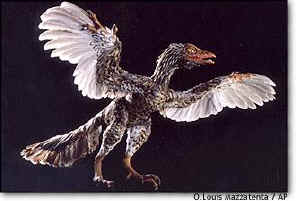
بعد صدور كتاب دارون ((الأصل في الأنواع))، تم اكتشاف أحفورة لطائر عتيق اعتبر أحد أهم حلقات الوصل بين الديناصور والطيور الحديثة أعطي اسم Archaeopteryx، وكان ذلك في 1860، ثم اكتشفت أحافير أخرى لنفس الطائر في سنوات 1861، 1876، 1956، 1970، 1974، 1988، 1991، وبعضها أحافير محفوظة تظهر الريش والدماغ.
Museum of Natural History- Berlin

يجمع هذا الطائر خصائص الديناصور والطير معا:
* جناح ذو ريش
* ذيل عظمي ثقيل
* التشريح الدماغي يأخذ حجما وسطا بينهما، وهو شبيه بدماغ الطائر والذي يساعده على قنص الفريسة.
* أذن داخلية أعقد من الديناصورات تتيح له توازنا أعلى.
* فك وأسنان.
المصادر
http://news.nationalgeographic.com/news/2004/08/0804_040804_archaeopteryx.html
http://www.dinosauria.com/jdp/jdp.htm
وبعمل مقارنة تشريحية كاملة بينه وبين الديناصور والطير.. يتضح لنا الحالة الوسطية بينهما:
1 = present; * = present in some; ? = possibly present; x = absent
Dinosaurs Archae Birds
1 * 1 1
2 x 1 1
3 * 1 1
4 * 1 1
5 x x 1
6 x x 1
7 * x 1
8 * 1 x
9 1 1 x
10 1 1 x
11 1 1 x
12 1 1 x
13 1 1 x
14 1 1 x
15 1 1 x
16 6 6 11-23
17 1 1 x
18 1 1 *
19 1 1 x
20 1 1 x
21 1 1 x
22 1 1 x
23 1 1 x
1
) Feathers.
2) Opposable hallux (big toe).
This also is a character of birds and not of dinosaurs.
3) Furcula (wishbone) formed of two clavicles fused together in the midline.
4) Pubis elongate and directed backward.
5) Premaxilla and maxilla are not horn-covered.
6) Trunk region vertebra are free.
In birds the trunk vertebrae are always fused.
7) Bones are pneumatic.
8) Pubic shafts with a plate-like, and slightly angled transverse cross-section
A Character shared with dromaeosaurs but not with other dinosaurs or birds
9) Cerebral hemispheres elongate, slender and cerebellum is situated behind the mid-brain and doesn't overlap it from behind or press down on it
10) Neck attaches to skull from the rear as in dinosaurs not from below as in modern birds.
11) Center of cervical vertebrae have simple concave articular facets.
12) Long bony tail with many free vertebrae up to tip (no pygostyle).
13) Premaxilla and maxilla bones bear teeth.
14) Ribs slender, without joints or uncinate processes and do not articulate with the sternum.
15) Pelvic girdle and femur joint is archosaurian rather than avian (except for the backward pointing pubis as mentioned above).
16) The Sacrum (the vertebrae developed for the attachment of pelvic girdle) occupies 6 vertebra.
17) Metacarpals (hand) free (except 3rd metacarpal), wrist hand joint flexible
18) Nasal opening far forward, separated from the eye by a large preorbital fenestra (hole).
19) Deltoid ridge of the humerus faces anteriorly as do the radial and ulnar condyles.
20) Claws on 3 unfused digits.
21) The fibula is equal in length to the tibia in the leg.
22) Metatarsals (foot bones) free. .
23) Gastralia "ventral ribs" present
. 2) Opposable hallux (big toe).
This also is a character of birds and not of dinosaurs.
3) Furcula (wishbone) formed of two clavicles fused together in the midline.
4) Pubis elongate and directed backward.
5) Premaxilla and maxilla are not horn-covered.
6) Trunk region vertebra are free.
In birds the trunk vertebrae are always fused.
7) Bones are pneumatic.
8) Pubic shafts with a plate-like, and slightly angled transverse cross-section
A Character shared with dromaeosaurs but not with other dinosaurs or birds
9) Cerebral hemispheres elongate, slender and cerebellum is situated behind the mid-brain and doesn't overlap it from behind or press down on it
10) Neck attaches to skull from the rear as in dinosaurs not from below as in modern birds.
11) Center of cervical vertebrae have simple concave articular facets.
12) Long bony tail with many free vertebrae up to tip (no pygostyle).
13) Premaxilla and maxilla bones bear teeth.
14) Ribs slender, without joints or uncinate processes and do not articulate with the sternum.
15) Pelvic girdle and femur joint is archosaurian rather than avian (except for the backward pointing pubis as mentioned above).
16) The Sacrum (the vertebrae developed for the attachment of pelvic girdle) occupies 6 vertebra.
17) Metacarpals (hand) free (except 3rd metacarpal), wrist hand joint flexible
18) Nasal opening far forward, separated from the eye by a large preorbital fenestra (hole).
19) Deltoid ridge of the humerus faces anteriorly as do the radial and ulnar condyles.
20) Claws on 3 unfused digits.
21) The fibula is equal in length to the tibia in the leg.
22) Metatarsals (foot bones) free. .
23) Gastralia "ventral ribs" present
وبخصوص التغيرات الطارئة على الأطراف والممهدة للطيران، نجد:
* شكل تشريحي لعظام الرسغ متوسط بين الديناصور والطير رافد القص Carniates الحديث، اذ أن عظمة هِلي (( Lunate)) تأخذ شكلا نصف كروي، والطرف نصف الكروي يتمفصل مع الرسغ مما يعطيه خاصية المرونة ( لكن بالطبع ليست بدرجة المرونة النهائية للطيور).
*عظم الكتف و شكله التشريحي يتوسط بين الديناصورات السابقة Theropod والطيور الحديثة Carniates، مما مهد المرونة للطيران.
*******
أرجو المراعاة التامة، فما قرأتموه سابقا أخذ مني أكثر من 5 ساعات في البحث عن المصادر والتلخيص والترجمة.
تحية




Comment